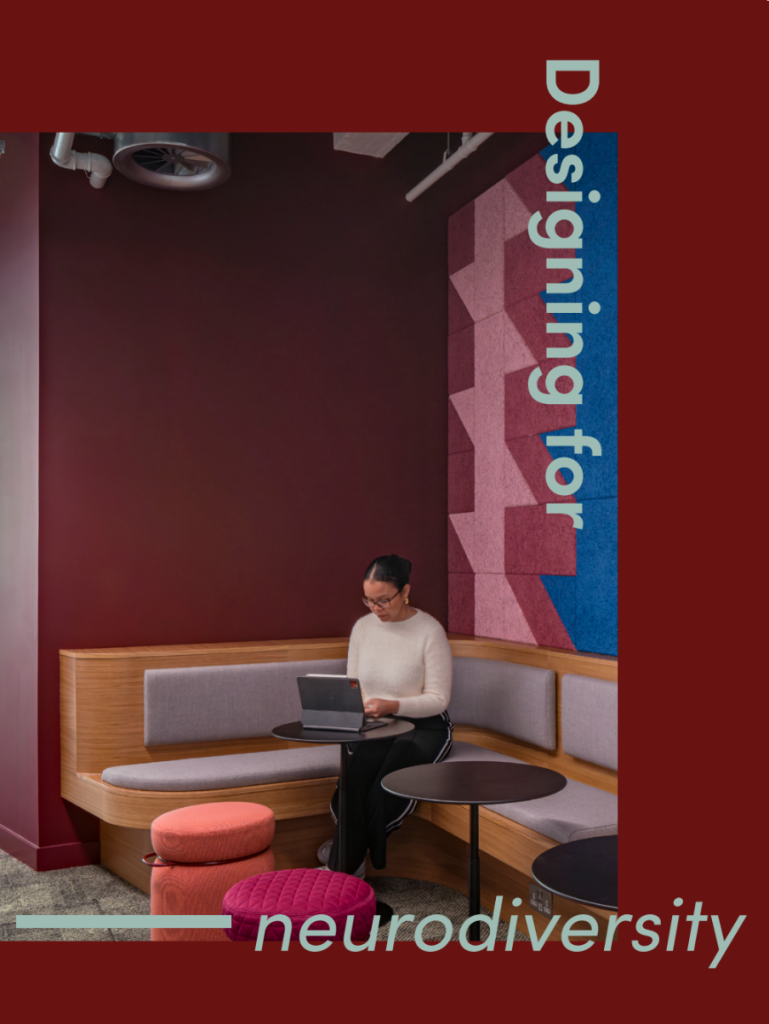
Workplace design has evolved significantly over the past decade. First came efficiency and density, then collaboration, culture and experience. More recently, however, the conversation has shifted towards wellbeing, flexibility and choice. With that, one of the most important shifts in the built environment is only now beginning to take hold – neurodiversity.
Often positioned as a specialist topic, neurodiversity in design is still too frequently reduced to a checklist: quieter rooms, softer lighting, acoustic panels. But, in reality, it raises a much broader question: “why have we accepted workplaces that ask everyone to perform in exactly the same conditions?”
This guide explores how offices can better reflect the reality of human variation – recognising that people experience space differently, move between different tasks throughout the day, and need environments that support focus, collaboration, recovery and creativity.
Drawing on insights from a roundtable hosted by Agilité, the guide brings together perspectives from workplace design, lighting, engineering, neuroscience and delivery to explore how neuro-inclusive thinking is shaping the next generation of offices.
This discussion was shaped by a small group of practitioners working across workplace design, engineering and delivery in the UK and Europe. Hosted by Agilité, the roundtable brought together Maria Luisa Daglia, Italy country head, and Matteo Bonotto, design manager at Agilité; James Lawrence, strategy director at Gensler; Neege Allen, founder of mono nexo; Francesco Guastella, project manager lighting and lead lighting designer, and Fabio Viero, chief innovation officer at ESA engineering; alongside Davide Ruzzon, director at Tuning Arch and NAAD Director (Neuroscience Applied to Architecture) at the University Iuav of Venice.
Explore why neuro-inclusive workplace design is not about adding something new, but recognising what was always there.
careers@agilitesolutions.com
FR +33 (0) 1 88 61 81 31
UK+44 (0)7 506 403 069
IT +39 (0) 350 9646921
LUX +352 (0) 621 481 103



"*" indicates required fields


