Sustainability commitments are easy to make. The hard part is turning ambition into action, and action into measurable impact. For responsible business to mean something, it cannot sit in a separate strategy document, certification folder or marketing campaign, it has to shape the way a company makes decisions, supports clients, works with suppliers and grows across different markets.
That’s exactly what our operational excellence director, Kirsty Shearer, has been discussing on the ‘emission possible’ podcast with Alan Stenson, podcast host and CEO at Neutral Carbon Zone. Listen to the episode here.

For Agilité – a commercial interiors specialist working across multiple European markets – sustainability is not a single workstream but something that connects to procurement, project planning, impact reporting, supplier engagement, health and safety, quality, waste reduction, social value, culture and client relationships. In practice, it touches almost every part of the business. So, what are the key takeaways?
Responsible growth depends on having the right systems, standards and behaviours in place, so teams can deliver consistently across different countries, clients, regulations and project environments. It is not about creating process for the sake of it. It is about giving people the tools, structure and information they need to make better decisions.
External frameworks can help create that structure, and Agilité’s work around B Corp, EcoVadis and Neutral Carbon Zone certification has given the business different ways to assess performance, identify gaps and strengthen accountability, as each framework brings a different lens.
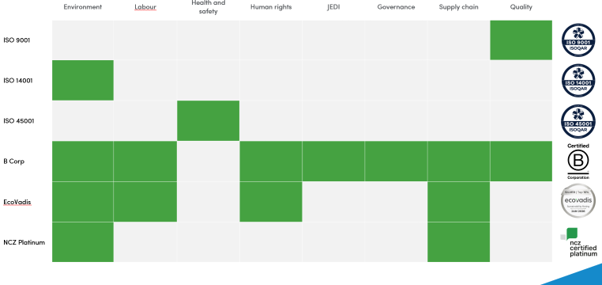
As we often say, certification is not the final outcome. The real value comes from what happens afterwards: what the business learns, what changes, who takes ownership and how improvements are embedded into daily operations. Recertification and audits help keep that momentum alive, because the standards continue to evolve – you cannot stand still, and if you started the journey for the right reasons, you would not want to.
Sustainability isn’t a standalone component of what you do, it needs to become part of the business structure. As a company grows, that mindset has to be embedded into procurement, project delivery and decision-making, so responsible habits become the standard way of working.
That only happens when colleagues understand what sustainability means in their own roles. A project manager, cost estimator, HR manager, marketing specialist or country head will each influence responsible business in different ways, so the challenge is to make the principles practical, not abstract.
In fit-out, this also means challenging old assumptions. There was a time when sustainable materials were often seen as cost-prohibitive, or as a compromise on quality, but that is no longer the case. Better options exist, but teams need the curiosity and confidence to go looking for them.
Supplier engagement is essential, but also complex. Agilité works with suppliers across different countries, sectors and levels of maturity, some already have detailed data relating to emissions and reporting systems while others – particularly smaller local businesses – may be earlier in the journey. Meaningful progress depends on bringing suppliers with the business, rather than overwhelming them with requirements they do not yet have the resources to meet.
The quality of the conversation matters. Asking clearer questions, explaining why information is needed, and building expectations over time can help turn carbon reporting into a practical tool for improvement, rather than another administrative burden. And, major, expensive overhauls are not always the answer. Small changes, such as adjusting tap components to reduce water flow, can have a significant cumulative impact across the lifecycle of a project.
Clients no longer want to see sustainability referenced on a single tender page or talked about during a pitch. Increasingly, they are looking for evidence of real impact, with data around greenhouse gases, resource consumption, responsible procurement, social value and supply chain standards that complement their own commitments.
At the same time, commercial realities remain, and price, programme and risk still play a central role in decision-making. Responsible business performance becomes commercially valuable when it is specific, credible and connected to outcomes clients care about. Strong evidence can build trust, reduce risk, support long-term relationships and help differentiate a business when competing proposals are otherwise closely matched.
You cannot improve what you do not track. For Agilité, starting with a carbon footprint baseline was an essential first step, particularly in understanding Scope 3 supply chain emissions. Once we knew where we stood, we could start identifying where changes would make the biggest difference, and how progress could be measured over time.
Positive data can also help bring people with you. When colleagues can see that decisions around materials, travel or project initiatives are moving the needle, it creates momentum. But transparency matters just as much when the results are less positive – sharing what is not working can open up new conversations, ideas and improvements.
That credibility is central to responsible business communication, and you can celebrate progress without suggesting the work is complete. Vague claims are not enough, so messaging should be specific, evidenced and honest about both achievements and areas still being improved.
The next stage of Agilité’s responsible business journey is about deepening the work already underway. That includes improving carbon data quality, strengthening supplier engagement, developing responsible procurement, preparing for our B Corp recertification, and making sure ESG commitments keep shaping everyday decisions.
For any business unsure where to begin, the first step is not to do everything at once, but to understand where the biggest impacts sit, choose a small number of priorities, assign ownership and start building better habits. Meaningful progress becomes possible when good intentions are turned into systems, decisions and behaviours.
Listen to the full conversation with Neutral Carbon Zone here.

careers@agilitesolutions.com
FR +33 (0) 1 88 61 81 31
UK+44 (0)7 506 403 069
IT +39 (0) 350 9646921
LUX +352 (0) 621 481 103
DE +49 30 2239 9548 83


"*" indicates required fields


